How to Eat Kimchi Jjigae (Kimchi Stew) the Korean Way
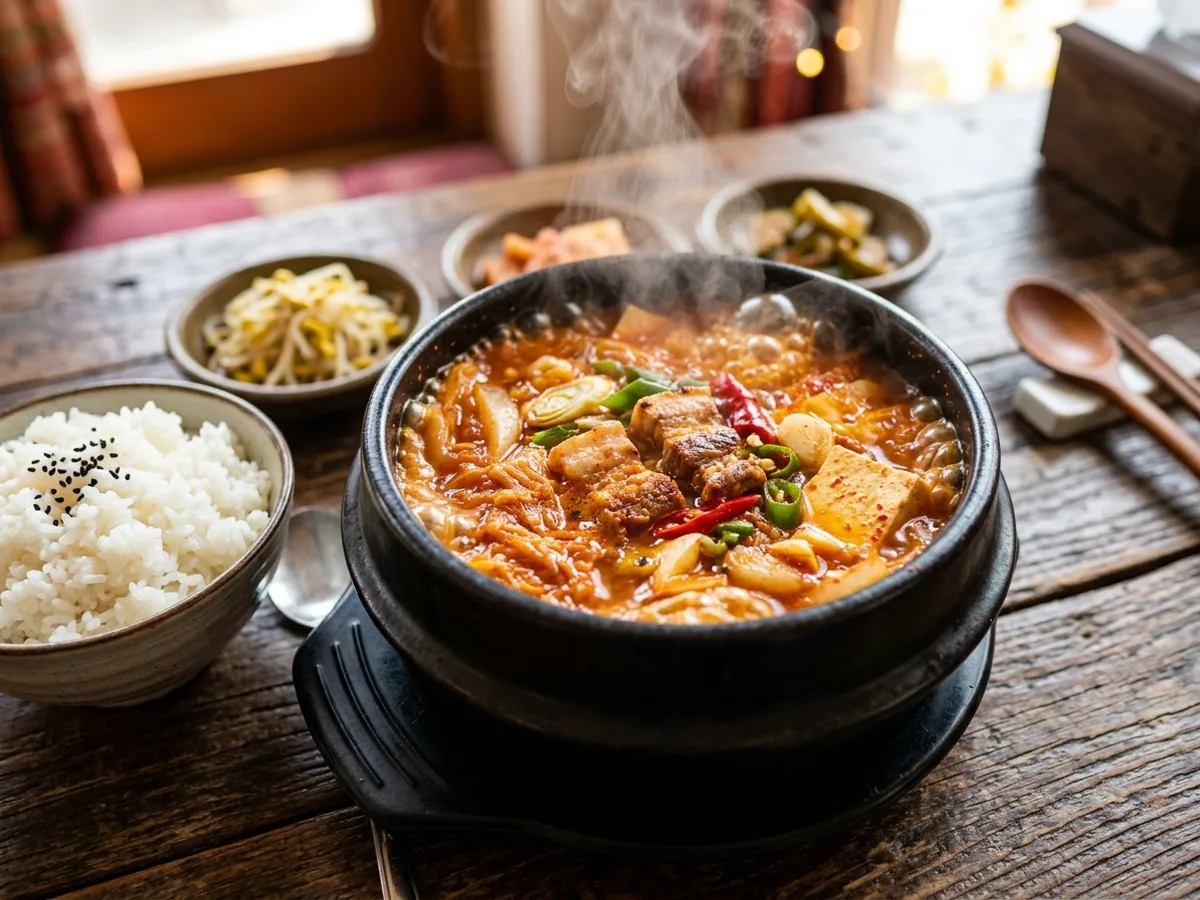
Kimchi jjigae (김치찌개) is Korea’s default comfort food — the dish Koreans abroad say they miss first. It’s sour, spicy, savory, and it lands on your table still boiling, which is exactly the moment most visitors freeze up. Here’s the full script.
What you’re ordering
Kimchi jjigae is a stew of aged, sour kimchi simmered with either pork (돼지고기 김치찌개, the classic) or tuna (참치 김치찌개), plus tofu, onion and scallion. At lunch places you order it as a set — the stew, a bowl of rice, and a spread of side dishes come together, typically for ₩8,000–₩11,000.
One useful signal: restaurants that specialize in it often brag about their kimchi’s age. “묵은지” (mugeunji) on a sign means extra-aged kimchi — deeper, sourer, and generally a very good sign.
Why it’s still boiling (and what to do)
The stew is served in a stone or steel pot straight off the flame, and it will keep bubbling at your table for a minute or two. Nobody expects you to eat it like that.
- Put rice on your spoon first, then dip into the stew for broth and a piece of pork or tofu. The rice tames the temperature and the spice at once.
- Don’t lift the pot or the bowl — everything stays on the table. Spoon travels; dishes don’t.
- Blow on each spoonful. Completely normal at every age.
- If it’s a shared pot, use the serving ladle if one’s provided; among close company, everyone’s spoon going in is normal.
How locals actually eat it
The stew is not eaten “first” or “last” — it runs in parallel with everything else on the table. A spoonful of stew, a bite of rice, a pinch of side dish, repeat. Two habits worth copying:
- Rice into the stew, late in the meal. Many locals finish by putting the last of their rice directly into the remaining broth, making a loose, intensely flavored porridge. Nobody will blink.
- The pork belongs to everyone. In a shared pot, don’t fish out all the meat early — it’s the shared prize.
Price and where to go
Kimchi jjigae is a lunch-hour institution: office-district restaurants turn it over fast, which keeps it fresh and cheap (₩8,000–₩11,000 with rice and sides). As with most Korean staples, a no-frills place packed at 12:10pm on a weekday is a better bet than anywhere with a translated tourist menu.
Good to know: kimchi jjigae is one of the few dishes where “old” is a compliment. Fresh kimchi makes a flat stew — the sour, funky depth only comes from kimchi that’s been fermenting for months.
Nutrition
| Calories | 61 kcal |
|---|---|
| Carbohydrate | 2.98 g |
| Protein | 3.77 g |
| Fat | 3.75 g |
| Sodium | 491 mg |
Per serving (~400g): ≈244 kcal · sodium ≈1,964 mg (98% of the WHO daily guideline, 2,000 mg)
FAQ
Is kimchi jjigae eaten as a soup course or a main dish?
It's the main dish. In Korea a stew isn't a starter — it anchors the whole meal, eaten together with a bowl of rice and shared side dishes, spoonful by spoonful throughout.
Do you drink kimchi jjigae straight from the bowl?
No — use the spoon. Korean table manners keep bowls on the table; you bring stew to your rice or mouth with a spoon rather than lifting and sipping from the bowl.
Is it rude to share one pot of kimchi jjigae?
Sharing is the norm, not an exception. A single pot in the middle of the table with everyone's spoons is standard among friends and family, though many restaurants now serve individual pots and offer a shared ladle if you ask.
How spicy is kimchi jjigae really?
Moderate by Korean standards — warming rather than punishing. The heat comes from fermented kimchi rather than raw chili, so it's more sour-savory-spicy than sharp. If you handle sriracha comfortably, you'll manage.