How to Eat Samgyeopsal (Korean BBQ Pork Belly) Like a Local
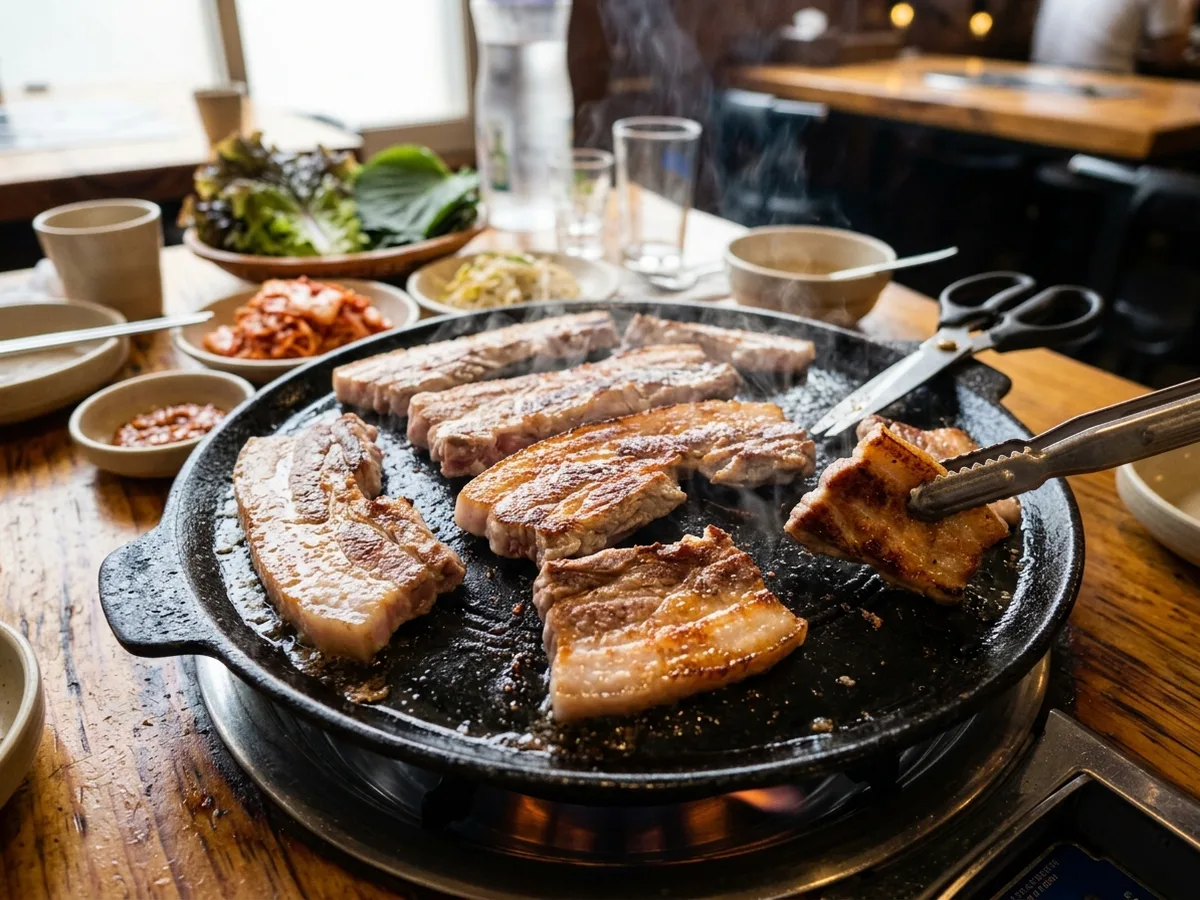
Samgyeopsal (삼겹살) — thick slices of pork belly grilled at your table — is the default “let’s eat out” meal in Korea. It’s also the meal most likely to confuse a first-timer, because nothing arrives cooked and nobody explains the rules. Here’s the whole thing, start to finish.
What you’re ordering
Samgyeopsal means “three-layer meat” — pork belly with its layers of meat and fat. On the menu you’ll usually see:
| Menu item | What it is |
|---|---|
| 삼겹살 (samgyeopsal) | Plain pork belly — the classic |
| 목살 (moksal) | Pork shoulder/neck — leaner, still juicy |
| 항정살 (hangjeongsal) | Pork jowl — pale, chewy, prized |
Portions are per 1인분 (one serving, usually 150–180g), and almost every restaurant needs a 2-portion minimum to fire up the grill. Ordering “sam-gyeop-sal i-in-bun” (삼겹살 2인분) with two fingers up works fine.
What arrives at the table (all of it is free)
Before the meat, the table fills up: lettuce and perilla leaves, ssamjang (the brown-red dipping paste), raw garlic and green chili, kimchi, bean sprouts, and often a salted-sesame-oil dip for the meat itself. Many places add pa-jeori (파절이, a sharp scallion salad), pickled onion, and ssam-mu (thin sweet-sour radish wraps) — their acidity is there to cut the pork’s richness, and rotating them between bites is how locals keep a fatty meal from getting heavy. All side dishes are free and refillable — flag a staff member or press the table bell and ask for more.
How to grill, step by step
- Let the grill get properly hot before the meat goes on — staff usually light it and will tell you when it’s ready.
- Lay the slices flat, don’t crowd them. You’ll hear a serious sizzle if the temperature is right.
- Flip once the underside is golden — not before. Constant flipping is the number-one beginner mistake; the meat steams instead of crisping.
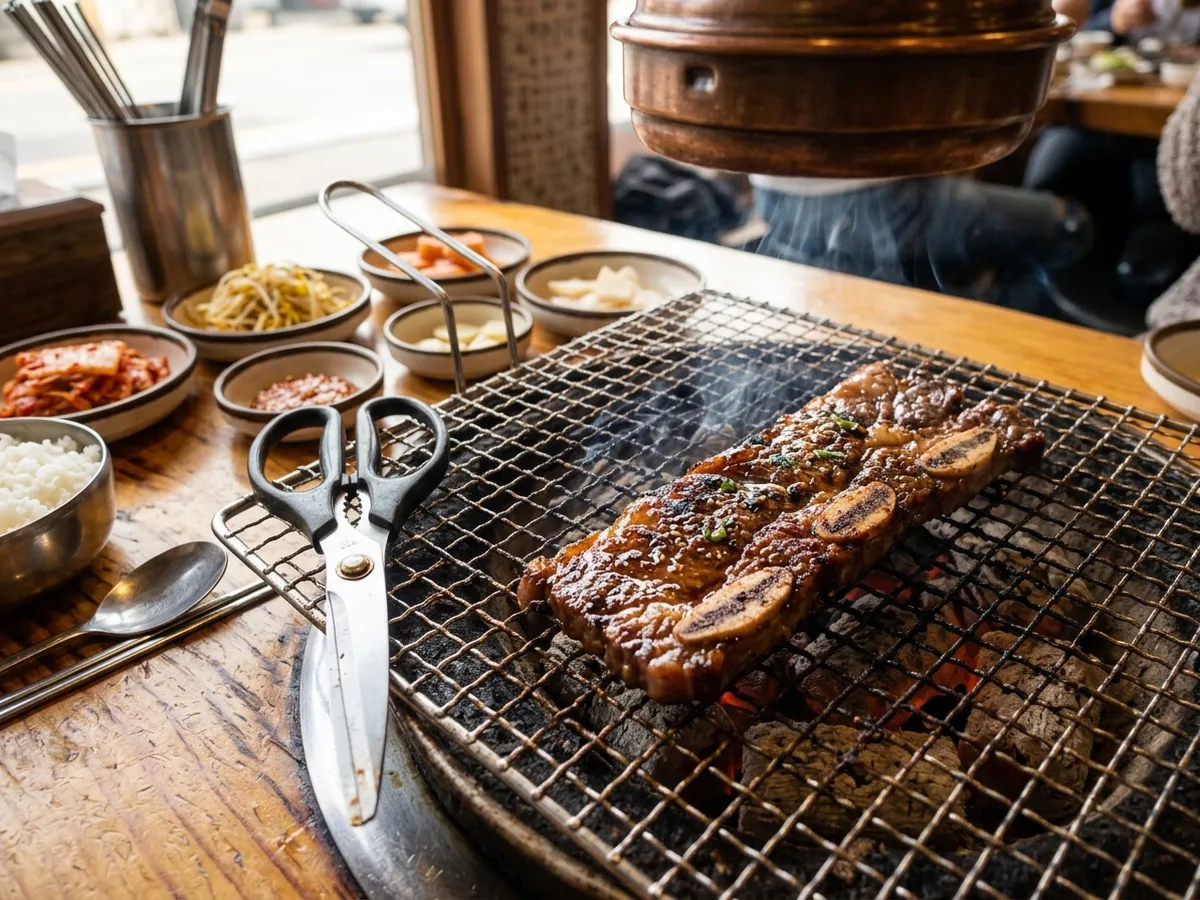
- Cut with the scissors after the first flip: hold with tongs, snip into bite-size pieces right on the grill. Scissors are standard equipment, not a hack.
- Move done pieces to the cooler edge of the grill so they stay warm without burning while the next batch cooks.
- Grill the extras — but late. Kimchi and garlic go on after the pork has released its fat, and they cook in it. Kimchi’s seasoning and sugars burn much faster than the meat, so keep it away from the hottest spot. (Grilling the garlic also mellows it — the standard move if raw garlic is too much for you.)
- Keep the raw-meat tongs and your own chopsticks separate. Tongs and scissors handle the raw pork; your chopsticks only touch cooked pieces. Koreans follow this automatically, and it’s the one hygiene rule of the table.
- When the plate gets crusted with burnt residue, ask for a new one — “판 갈아주세요” (pan gara-juseyo). Swapping grill plates mid-meal is completely routine, not an imposition.
How to build a ssam (wrap)
First, though: eat your first piece or two with just the salt dip, no wrap. Locals do this to taste the pork itself before the seasonings take over — it’s also how you judge whether the restaurant is any good. Then build wraps:
- One leaf on your palm (lettuce for fresh, perilla for aroma — or both stacked).
- One or two pieces of pork.
- A small dab of ssamjang — it’s strong; less than you think.
- Optional: grilled garlic, a slice of chili, a piece of kimchi.
- Fold it shut and eat the whole thing in one bite. Two bites and it collapses — locals just make smaller wraps. The most common beginner error is overstuffing: if it won’t close easily, it’s already too big.
How locals finish the meal
When the meat is done, the meal isn’t. The classic endings, ordered from the same menu:
- 된장찌개 (doenjang jjigae) — soybean paste stew, shared, with rice
- 냉면 (naengmyeon) — ice-cold noodles, the “cool down” finish, especially in summer
- 볶음밥 (bokkeumbap) — fried rice made in the leftover pork fat on your grill, if the restaurant offers it. If you see it on the menu, get it.
Price and where to go
Expect roughly ₩12,000–₩20,000 per portion depending on the neighborhood and quality tier. A filling dinner for two with drinks usually lands around ₩40,000–₩60,000. Every neighborhood in every Korean city has samgyeopsal restaurants — as a rule of thumb, a place full of office workers at 7pm on a weekday is a safe bet.
🍳 Want to make it at home? How to Cook Samgyeopsal at Home: No Oil, No Marinade, No MysteryLocal habit worth copying: pace the grilling to the eating. Cook two or three portions’ worth across the whole meal instead of all at once — samgyeopsal is meant to be eaten hot off the grill, round after round.
Nutrition
| Calories | 467 kcal |
|---|---|
| Carbohydrate | 0.35 g |
| Protein | 22.56 g |
| Fat | 41.69 g |
| Sodium | 576 mg |
Per serving (~200g): ≈934 kcal · sodium ≈1,152 mg (58% of the WHO daily guideline, 2,000 mg)
FAQ
Do I have to grill the meat myself at a Korean BBQ restaurant?
Usually yes — grilling at the table is part of the meal. At many places staff will help start the first round, and it's completely fine to let the most confident person at the table take over the tongs. Solo diner? Staff will often keep an eye on your grill.
What is the green leaf for at Korean BBQ?
That's for ssam — a wrap. Put a slice of grilled pork on the leaf (lettuce or perilla), add ssamjang paste and anything else you like, fold it closed, and eat the whole thing in one bite.
How much samgyeopsal should I order per person?
Most restaurants require a minimum of 2 portions (2인분) to light the grill. A typical portion is 150–180g; hungry adults usually eat 1.5–2 portions each, then finish with rice, naengmyeon or doenjang stew.
Is it rude to eat ssam in two bites?
Not rude, just impractical — the wrap falls apart. Locals build smaller wraps instead of taking two bites of a big one. One bite is the way.